Skip to content

HF Antenna for My Kenwood TH-F6A

My Kenwood TH-F6A handheld will receive HF frequencies. The stock antenna does a very poor job at that (I might as well had a dummy load hooked up instead of the antenna).  I was anxious to see if something more closely resembling an normal HF antenna might help.

I ordered an SMA-BNC adapter from Thor Labs. It arrived today.  I used it to connect the DX-EE trap dipole in the attic to the TH-F6A and it worked wonderfully!

For my next QRP outing I’m putting together a portable inverted Vee for 40 meters.  I will bring the TH-F6A along and test it with that antenna as well.

I Need Another Antenna

I don’t think there is a ham alive who thinks he has enough antennas.

I have an Alpha-Delta DX-EE trapped dipole for 40/20/15/10 Meters in my second story attic.  It is oriented north-south and so it’s radiation pattern is east-west. LIke all dipoles however it has deep nulls off the ends.

Too many times (like today) I’ve had South American stations come booming in here but they cannot hear me.

The Plan: The eaves on the back side of the house is oriented almost exactly east-west.  The peak of the roof is about 30 feet off the ground.  Perfect for a 15/20M trapped inverted Vee.

Since, it’s sumer here in Arizona though, I think this will be a Fall project.

Rain Gutter Antenna, Part 2

The rain gutter antenna is up and running.

A-B testing against the attic dipole shows that it is best on 40M and 80M.  It is quieter and the signals are stronger.  On 20M, both the signal and the noise are both down, but the noise is down more than the signal.

I’m tuning it using an SG-230 SmartTuner and it’s fun to watch the SWR-meter as it is working. When I go key-down the SWR-Meter needle dances around for a second or two and then BAM! the SWR goes to almost 1:1.

Thinking About Low-Noise Receiving Antennas

I’m considering installing some sort of low-noise receiving antenna.  The static on 20M here is sometimes S9.  The past few days I’ve heard some European stations but they were too far buried in the noise for me to pull them out. Even my TS-590’s DSP NR circuits are not enough.

My house is at the back of my subdivision and there is a vacant area behind me that extends eastward for 5-6 houses, or approximately 240 feet – enough for a beverage antenna.  My TS-590 has a separate jack on the rear panel for a RX antenna.

Time to order some magnet wire.

Modeling the Raingutter Antenna Using EZNEC

While browsing in Ham Radio Outlet a few days ago, I saw an ARRL book Antenna Modeling For Beginners. I bought it and decided to use my raingutter antenna as a learning example.

I am continually amazed at the technological advances in ham radio in my 10 year absence.  My TS-590S is an absolute miracle radio compared to the old HW-100 that I started out with.  My MFB-269 antenna analyzer: Had such a thing existed 20 years ago (thou if it had I was too poor to afford one) it would have saved me SO MUCH time and energy.

And now I’ve discovered that simple-to-use antenna modeling software is actually available free. Of course, I’m not sure how much relationship to reality there will be in the outputs. If EZNEC can model the fact that my raingutter is mounted on a stucco house and to it sits at the top if a big vertical rectangle (the wall) that is stucco over chicken wire, then I am not yet aware of it. Anyway, here’s what I get:

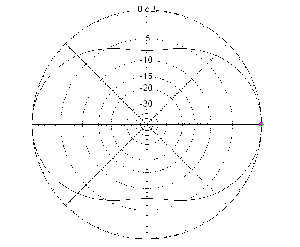
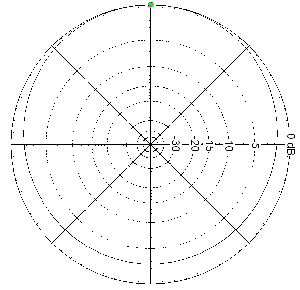
40M 1/4 Wave Dipole as a reference (North is at the top):

DipolePlot_40M_NorthatTop300

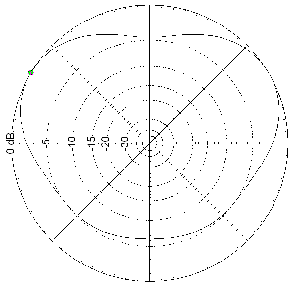
Raingutter at 20M (North is at the top):

Raingutterplot_20M_NatTop300


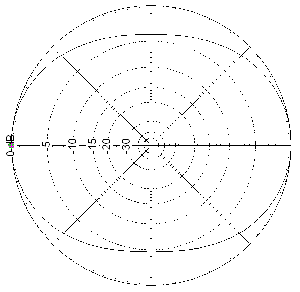
Raingutter at 40M (North at the top):

raingutterplot_40M_NatTop300


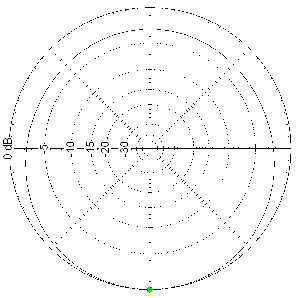
Raingutter at 80M (North at the top):

raingutterplot_80M_NatTop300

Raingutter at 160M (North at the top):

raingutterplot_160M_NatTop300


Rain Gutter Antenna, Part 1

I live in an antenna-restricted neighborhood.  Furthermore, the HOA police drive through every week looking for violations. (I’ve been known to have fun with them by planting pink flamingoes in my front yard but that’s another story).

Not long ago, I was standing outside looking at my house wondering how best to disguise an antenna when it hit me: Rain Gutter!

It cost about $500 to have 40 feet of seamless rain gutter and two 20ft downspouts installed on the east side of my house.  I found enough money in the budget to by an SG-230 Remote Tuner, which I plan to mount on the garage wall.

I need a ground system or counterpoise.  Good luck getting an earth ground here in Phoenix, AZ.  When the landscapers built a retaining wall in my backyard they ended up digging the footing with a jackhammer.

I can reasonably bury about four counterpoise wires, each about 50 feet long. Thats less than optimal, I know, but that’s about the best that can be done on my itty bitty residential lot. I buried the first one today along the east side of the house, directly below the rain gutter. I simply moved the landscaping gravel aside, laid the 14-guage wire down and then covered it back up.

Back To Top