Skip to content

Kenwood TS-590 Current Draw Measurements

After last weekend’s adventure taking the TS-590 out in the field, I started thinking about operating ‘picnic portable’.  The TS-590 is a really nice little compact radio and lends itself well to setting up at a remote location that does not require schlepping my gear for long distances. But how much current does it draw? What battery capacity will I need?  I decided to find out.

I have a Fluke 23 DMM that supposedly will measure DC current up to 10 Amps.  Probably not enough. What I needed was a shunt.  I love it that all the big electronic component supply houses are now on the internet. It took just a few minutes to discover that Newark has just what I needed, so I ordered one.

It arrived and I rigged up a quick wiring harness that would attach to the TS-590’s power cable (I love Anderson Powerpoles) and a 7.5Ah gel-cell battery.  This is what I found:

Output Power Amps
5W 8.4A
10W 9.0A
15W 10.2A
20W 11.4A
25W 13.2A
30W 13.8A
35W 14.4A
40W 15A
45W 16.2A
50W 17.4A

Some assumptions:
1. Using the discharge curves for the average gel-cell, I can really only use about 60% of the batteries capacity (in Amp-Hours) without damaging the battery.

2. I’m assuming 50% transmit and 50% receive.

If I operate ‘picnic portable’ at the 20 Watt power level then I need about 9.5Ah of battery capacity for each hour of operation.

BatterySpace.com has a 12V 20Ah SLA battery for $37.85 that would give me 2 hours of operation, which seems like a reasonable number.

QRP Portable Session 2

Undeterred by yesterday’s lack of success, I decided to try again today but shift my tactics a bit.

Last night I remembered that Thunderbird Park is not far from me, and there is an elevated spot with a covered ramada (shade!) that you can drive right up to and park.  No shlepping gear up a trail! I also decided to take both the KX-1 and the TS-590. My 7Ah gel-cell would provide a couple hours of operation  of the 590 and I could do a quick comparison of the two radios.

I left the hours at about 6:15am and by 6:45 was set up and operating.

Lesson 1: This non-huffing-and-puffing version of QRP operation is a lot more enjoyable.

Once again however, I could hear but know one could hear me.  I answered several CQs.  I called CQ myself several times. I tried both CW and SSB with the same (lack of) result.

I alternated between the TS-590 and the KX-1. Both rigs seemed to hear just as well. As long as the band is not crowded I think either rig will work just as well. Of course if the band is crowded or there is a lot of QRM the TS-590 with it’s DSP will run circles around the KX-1.

Lesson 2: I have a lot of learning to do. THis Saturday AZ ScQRPions are putting on a QRP conference in Flagstaff.  I think I will go.

Lesson 3: My CW speed needs to get to about 20wpm.


My First Attempt at QRP Portable

Now that I have everything necessary to operate QRP portable, I was anxious to give it a try.  The station consists of:

  • Elecraft KX-1
  • 7Ah gel-cell battery (too big and heavy, I know)
  • Antenna: 20 ft collapsable crappie pole and some speaker wire configured as a 20M dipole.

The weakest link on this chain of course was the operator. The next weakest link was the antenna, so I wanted to try to operate from a spot that was elevated. I live in Phoenix, AZ and Shaw Butte is not far from my house.  I’ve been to the top of Shaw Butte several times.  There is a ton of commercial repeaters up there, plus it’s quite a hike.  I chose a small hilltop that was about a third of the way up the trail as my operating position  You can see it in the photo below:

It’s Arizona. It’s summertime. whatever I did had to be early in the morning.  The temperature was 84 degrees when I left the house at 6:30am.  By 7:30 I was set up and operating.  Here is a 270-degree panoramic view from my operating spot:

Lesson 1: Trying to operate QRP portable for the first time while an IOTA contest is in full swing is not a good idea. I heard lots of signals.  Lots.  All at blinding-fast CW speeds.  After about an hour it was clear that my measly 4 watts and 10WPM were not going to get me anywhere that day.

I also decided that I do not like the KX-1 paddles.  The KX-1 paddles are touchy.  And the rubber sleeves on the paddles themselves stick to my sweaty fingertips. I guess I am spoiled by the light-but-solid touch of my Bencher paddles. Used Bencher paddles are about $60 so I’m temped to use one for this rig even though they are heavy.

By 8:30am the sweat was running down my face. It was also running off the brim of my hat and landing on the KX-1. I had consumed nearly all of the half gallon of water I brought along.  Though I had not made a single contact I knew the better part of valor was to call it a day.  I packed up and walked back down the trail to my car.  By 9:30 I was back in the air-conditioned comfort of my ham shack.


Giving QRP a Try

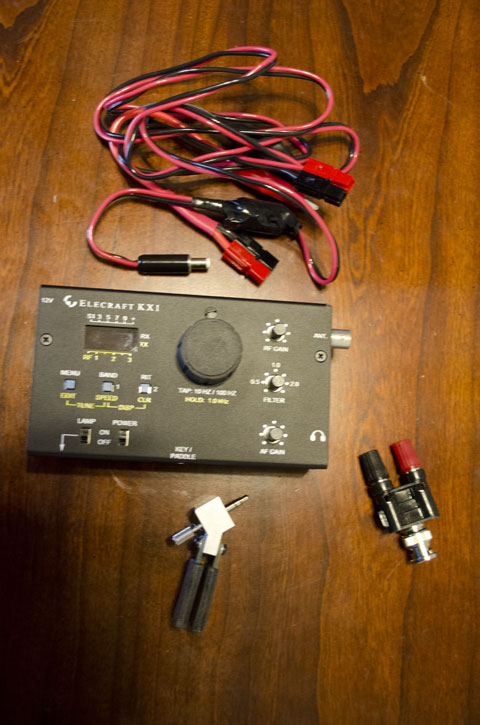
I’ve been getting the itch to try QRP operation. A nearby ham offered to sell me his fully-loaded Elecraft KX-1 for $400 and I could not pass it up.

I recently ordered this 20ft collapsable crappie pole from Amazon for about 20 bucks. That and some speaker wire will get me started antenna-wise.

Battery:

The KX-1 has an internal battery holder for six AA cells.  That provides about 9 volts which produces a little under two watts. At twelve volts the radio will produce about 4 watts, however.  Hmmmm.

A lot of guys rewire it to hold six of the 3.7V lithium batteries which gives 11.1 volts.

Since weight is not a huge factor at this point I’ve decided to go a slightly different route.  I’ve ordered a 7Ah gel cell battery and charger from batteryspace.com.  The 7Ah battery is really overkill.  Assuming 50% of the time is spent transmitting (which I think is pretty optimistic for QPR) then the KX-1’s average current draw will be about 400mAh, which means the gel-cell will provide about 12 hours of operation.

For another couple hundred bucks I can add a thin-film foldable 10W solar panel and charge controller, and I could operate indefinitely.  We’ll see how far I go with this.

There are some hills about 15 minutes from my house that will allow me to elevate my position by a few hundred feet. I plan to get up early some morning soon and give it a try.

I Need Another Antenna

I don’t think there is a ham alive who thinks he has enough antennas.

I have an Alpha-Delta DX-EE trapped dipole for 40/20/15/10 Meters in my second story attic.  It is oriented north-south and so it’s radiation pattern is east-west. LIke all dipoles however it has deep nulls off the ends.

Too many times (like today) I’ve had South American stations come booming in here but they cannot hear me.

The Plan: The eaves on the back side of the house is oriented almost exactly east-west.  The peak of the roof is about 30 feet off the ground.  Perfect for a 15/20M trapped inverted Vee.

Since, it’s sumer here in Arizona though, I think this will be a Fall project.

I’m now an Extra Class

One of my New Year’s resolutions for 2013 was to upgrade from a General to Amateur Extra.I accomlished that today.

I’d been casually studying using the Gordon West book but about three weeks ago I discovered two things:

  1. I took an online practice exam and almost passed it
  2. The local ham radio club would be holding VE testing in three weeks.

I’ve been hitting it pretty hard for the past three weeks, taking the online exam at qrz.com a couple times a day and giving the Gordon West book serious study.

Today I aced the exam.  That’s right. I aced it.  No one was more surprised then me.

Back To Top