Skip to content

Thoughts From a Returning Ham

I’m really getting a lot of enjoyment out of ham radio this time around.  I was inactive for about 15 years and got fired up again about 6 months ago. I promptly went out and bought a Kenwood TS-590s and put up an Alpa Delta DX-EE in the attic. Recently I added a Heil ProSet Elite headset.

Before the break my rig was a used Heathkit HW-100 that was old and tired when I bought it. Antennas were a mixture of dipoles, inverted Vs, and a beam up at about 25 feet. Each contact was a struggle.  Even minor pileups were impenetrable.

Things are different today. I certainly cannot compete with big guns but I’ve had no problems in minor pileups. I can make contacts with ease and have no trouble being understood. And that’s with 100 watts and a dipole in the attic.

A lot of it is the radio (I call the TS-590 a ‘Miracle Radio’). The speech processor adds punch to my signal on transmit and the DSP allows me to pull the signals out of the noise.  I have noticed a definite improvement since I added the Heil headset too.
 

Thoughts on LotW (Logbook of the World)

It seems like LOTW is all the range,  I dunno.

I take special delight in opening my mailbox and seeing a real physical QSL card from someone. I’m particularly fond of cards that have a photo of the operator, his shack, or some nearby landmark.


Perhaps I’m just old-fashioned.

MiniReview of Aether, Ham Radio Logging App for the Mac

I’m on a Mac.  A few months ago I started looking at the availability of ham radio-related Mac software.  For logging, I chose Aether.

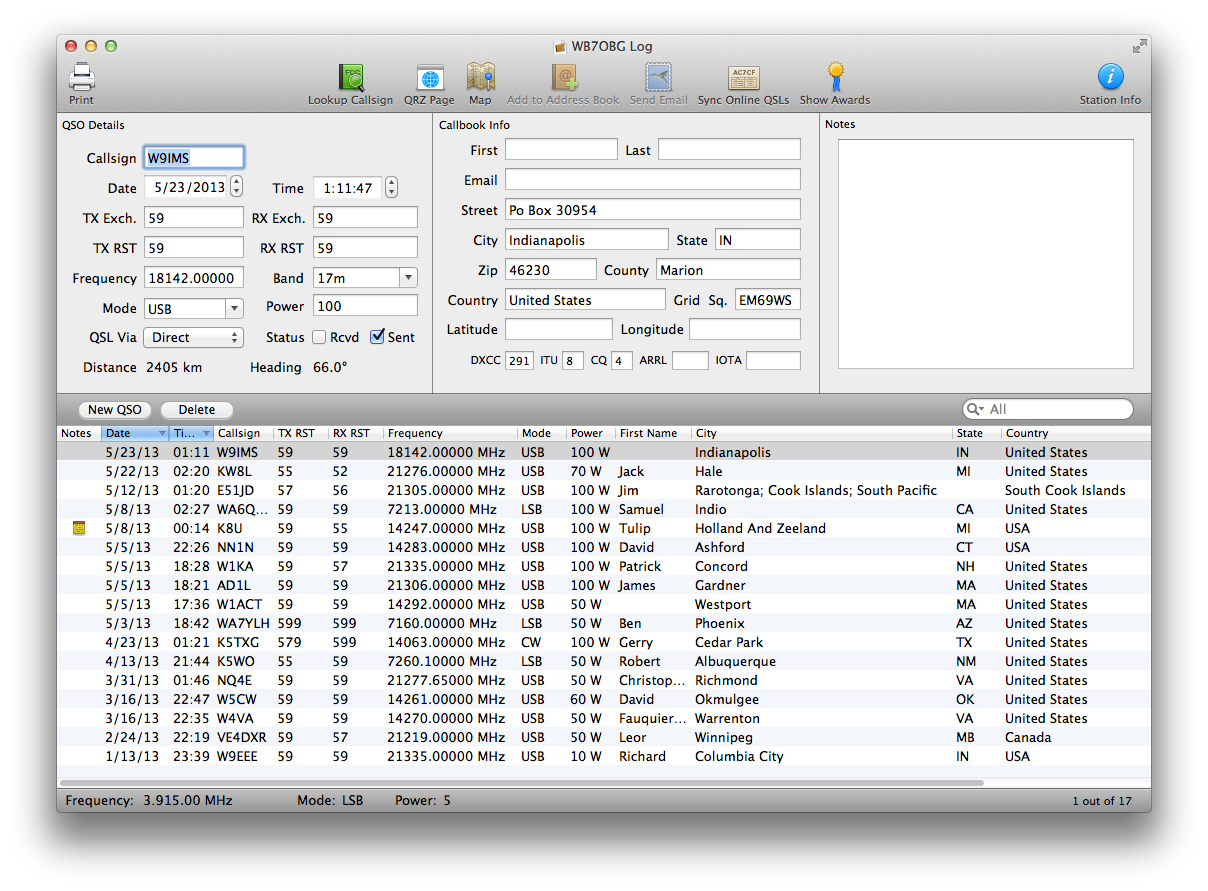
It is a nice clean native Mac application. It interfaces with hamQTH.com or QRZ.com for callsign lookup.  I happen to really like this feature.  While making a new logbook entry, the instant I enter the callsign it looks up the callsign nd automatically fills in the fields. It also automatically computes the beam heading and distance (If I had a beam I could put that feature to use).

It also interfaces very cleanly to my Kenwood TS-590S. I simply run a USB cable between the 590 and my USB hub.  When I create a new logbook entry it automatically fills in the frequency, mode, and power.

Aether also appears to work with cocoaModem but I have not yet played with cocoaModem.

The fully-functional Demo version is free and allows up to 30 logbook entries.  That should be enough time to evaluate it. The full version is $39.  Technical support via email is great.


TS-590 NR Controls Effectively Reduce Static

I’ve owned the Kenwood TS-590s for about 6 months and I’m still learning about it and discovering new capabilities. I’m discovering that careful adjustment of the Noise Reduction controls is very effective at removing static.

The background noise level on 20M is often S9 here, with many weak signals buried in the noise. A fe nights ago I started playing with the NR button and associated controls to see if I could reduce that static and much to my surprise I could.

There are two noise reduction circuits, NR1 and NR2. Repeatedly pressing the NR button cycles through OFF, NR1, and NR2. Holding down the NR button will NR1 or NR2 is displayed activates the MULTI/CH knob and makes the NR circuit adjustable. By careful adjustment,

I can take the background noise way down. It’s not perfect, and you can go overboard to the point that the desired signal gets distorted, so careful adjustments work best.

Modeling the Raingutter Antenna Using EZNEC

While browsing in Ham Radio Outlet a few days ago, I saw an ARRL book Antenna Modeling For Beginners. I bought it and decided to use my raingutter antenna as a learning example.

I am continually amazed at the technological advances in ham radio in my 10 year absence.  My TS-590S is an absolute miracle radio compared to the old HW-100 that I started out with.  My MFB-269 antenna analyzer: Had such a thing existed 20 years ago (thou if it had I was too poor to afford one) it would have saved me SO MUCH time and energy.

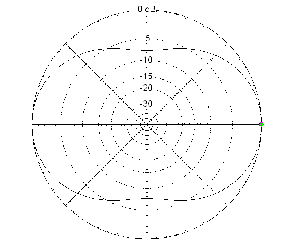
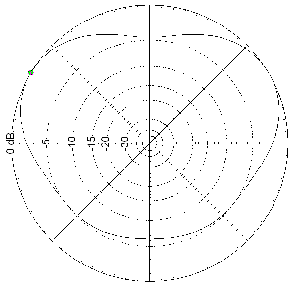
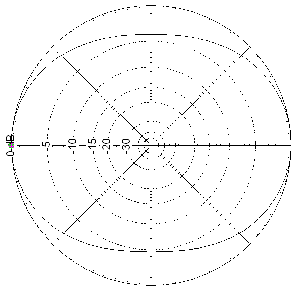
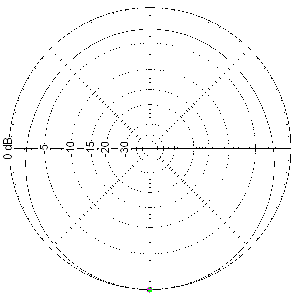
And now I’ve discovered that simple-to-use antenna modeling software is actually available free. Of course, I’m not sure how much relationship to reality there will be in the outputs. If EZNEC can model the fact that my raingutter is mounted on a stucco house and to it sits at the top if a big vertical rectangle (the wall) that is stucco over chicken wire, then I am not yet aware of it. Anyway, here’s what I get:

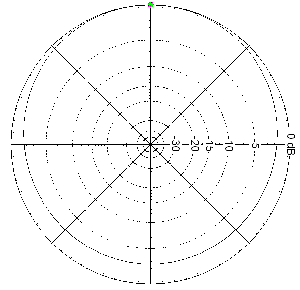
40M 1/4 Wave Dipole as a reference (North is at the top):

DipolePlot_40M_NorthatTop300

Raingutter at 20M (North is at the top):

Raingutterplot_20M_NatTop300


Raingutter at 40M (North at the top):

raingutterplot_40M_NatTop300


Raingutter at 80M (North at the top):

raingutterplot_80M_NatTop300

Raingutter at 160M (North at the top):

raingutterplot_160M_NatTop300


My FIrst DX Today

For the first time since being licensed in 1977 I’ve had a DX contact: E51JD, South Cook Islands. Needless to say, I’m walking on air right now.

Proof that 100 Watts and a dipole antenna in the attic can do the job.

Hearing DX

I’m hearing lots of Russian stations this morning on 15M. Last night I heard a station in Sweden. Unfortunately my signal isn’t reaching them.

Rain Gutter Antenna, Part 1

I live in an antenna-restricted neighborhood.  Furthermore, the HOA police drive through every week looking for violations. (I’ve been known to have fun with them by planting pink flamingoes in my front yard but that’s another story).

Not long ago, I was standing outside looking at my house wondering how best to disguise an antenna when it hit me: Rain Gutter!

It cost about $500 to have 40 feet of seamless rain gutter and two 20ft downspouts installed on the east side of my house.  I found enough money in the budget to by an SG-230 Remote Tuner, which I plan to mount on the garage wall.

I need a ground system or counterpoise.  Good luck getting an earth ground here in Phoenix, AZ.  When the landscapers built a retaining wall in my backyard they ended up digging the footing with a jackhammer.

I can reasonably bury about four counterpoise wires, each about 50 feet long. Thats less than optimal, I know, but that’s about the best that can be done on my itty bitty residential lot. I buried the first one today along the east side of the house, directly below the rain gutter. I simply moved the landscaping gravel aside, laid the 14-guage wire down and then covered it back up.

I Have To Start Somewhere

The journey of a thousand miles starts with a single footstep.

I registered this domain name a few months ago and finally decided it is time to turn it into a website.  My main motivation is to have the information I use organized in a single place.

Back To Top