Skip to content

Giving QRP a Try

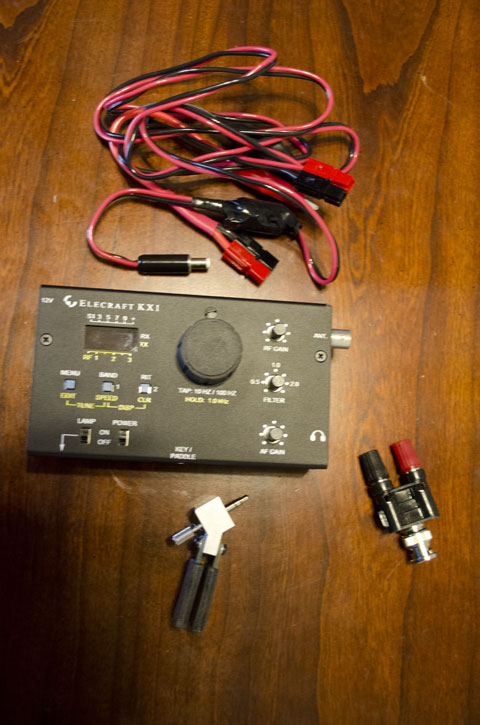
I’ve been getting the itch to try QRP operation. A nearby ham offered to sell me his fully-loaded Elecraft KX-1 for $400 and I could not pass it up.

I recently ordered this 20ft collapsable crappie pole from Amazon for about 20 bucks. That and some speaker wire will get me started antenna-wise.

Battery:

The KX-1 has an internal battery holder for six AA cells.  That provides about 9 volts which produces a little under two watts. At twelve volts the radio will produce about 4 watts, however.  Hmmmm.

A lot of guys rewire it to hold six of the 3.7V lithium batteries which gives 11.1 volts.

Since weight is not a huge factor at this point I’ve decided to go a slightly different route.  I’ve ordered a 7Ah gel cell battery and charger from batteryspace.com.  The 7Ah battery is really overkill.  Assuming 50% of the time is spent transmitting (which I think is pretty optimistic for QPR) then the KX-1’s average current draw will be about 400mAh, which means the gel-cell will provide about 12 hours of operation.

For another couple hundred bucks I can add a thin-film foldable 10W solar panel and charge controller, and I could operate indefinitely.  We’ll see how far I go with this.

There are some hills about 15 minutes from my house that will allow me to elevate my position by a few hundred feet. I plan to get up early some morning soon and give it a try.

I Need Another Antenna

I don’t think there is a ham alive who thinks he has enough antennas.

I have an Alpha-Delta DX-EE trapped dipole for 40/20/15/10 Meters in my second story attic.  It is oriented north-south and so it’s radiation pattern is east-west. LIke all dipoles however it has deep nulls off the ends.

Too many times (like today) I’ve had South American stations come booming in here but they cannot hear me.

The Plan: The eaves on the back side of the house is oriented almost exactly east-west.  The peak of the roof is about 30 feet off the ground.  Perfect for a 15/20M trapped inverted Vee.

Since, it’s sumer here in Arizona though, I think this will be a Fall project.

I’m now an Extra Class

One of my New Year’s resolutions for 2013 was to upgrade from a General to Amateur Extra.I accomlished that today.

I’d been casually studying using the Gordon West book but about three weeks ago I discovered two things:

  1. I took an online practice exam and almost passed it
  2. The local ham radio club would be holding VE testing in three weeks.

I’ve been hitting it pretty hard for the past three weeks, taking the online exam at qrz.com a couple times a day and giving the Gordon West book serious study.

Today I aced the exam.  That’s right. I aced it.  No one was more surprised then me.

Rain Gutter Antenna, Part 2

The rain gutter antenna is up and running.

A-B testing against the attic dipole shows that it is best on 40M and 80M.  It is quieter and the signals are stronger.  On 20M, both the signal and the noise are both down, but the noise is down more than the signal.

I’m tuning it using an SG-230 SmartTuner and it’s fun to watch the SWR-meter as it is working. When I go key-down the SWR-Meter needle dances around for a second or two and then BAM! the SWR goes to almost 1:1.

Thinking About Low-Noise Receiving Antennas

I’m considering installing some sort of low-noise receiving antenna.  The static on 20M here is sometimes S9.  The past few days I’ve heard some European stations but they were too far buried in the noise for me to pull them out. Even my TS-590’s DSP NR circuits are not enough.

My house is at the back of my subdivision and there is a vacant area behind me that extends eastward for 5-6 houses, or approximately 240 feet – enough for a beverage antenna.  My TS-590 has a separate jack on the rear panel for a RX antenna.

Time to order some magnet wire.

Kenwood TM-D710A APRS – Getting Started

I recently bought a Kenwood TM-D710A to use at the VHF/UHF radio here at the home QTH, I’m slowly dipping my toes in the APRS pond.
GEtting it to receive and display APRS packets was a no-brainer:

  1. Turn radio on.
  2. Tune the left side (‘A in 710 parlance) to 144.390.
  3. Push the TNC button a couple of times until ‘APRS12’ appears at the top of the display.

Today I decided to take the next step and see of I could get it to ‘beacon’.   I configured the settings (NOTE: I do not claim these to be optimal settings.  This is simply what I used initially that worked):

Basic Settings (Menu 600)

  • My Callsign : WB7OBG
  • Beacon Type : APRS

Position  (Menu 605)

  • Name: Home
  • Lat/Lon : transcribed from a hand-held GPS (I do not have a GPS unit attached to the radio.  It’s a base station)

Beacon Information (Menu 606)

  • Speed: Off
  • Altitude: Off
  • Position Ambiguity: Off

Position Comment (Menu 607)

  • In Service

Status Text (Menu 608)

  • 1 Text: Home
  • 1 TX Rate: 1/4

Station Icon (Menu 610)

  • The little House symbol

Beacon TX Algorithm (Menu 611)

  • Method: Auto
  • Initial Interval: 10min
  • Decay Algorithm: Off
  • Proportional Pathing: Off

Verifying that it is Working

To verify that I was actually transmitting something intelligible, I went to:

http://aprs.fi

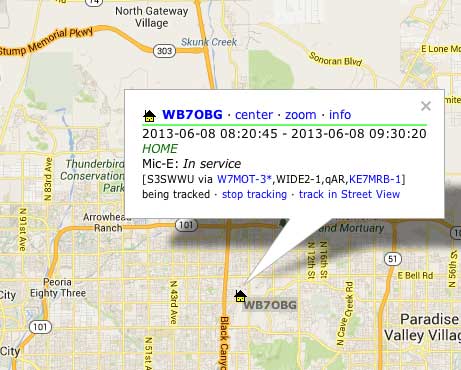
and entered my callsign in the ‘Track Callsign’ field and clicked search. Shazam!  There I was!


Thoughts From a Returning Ham

I’m really getting a lot of enjoyment out of ham radio this time around.  I was inactive for about 15 years and got fired up again about 6 months ago. I promptly went out and bought a Kenwood TS-590s and put up an Alpa Delta DX-EE in the attic. Recently I added a Heil ProSet Elite headset.

Before the break my rig was a used Heathkit HW-100 that was old and tired when I bought it. Antennas were a mixture of dipoles, inverted Vs, and a beam up at about 25 feet. Each contact was a struggle.  Even minor pileups were impenetrable.

Things are different today. I certainly cannot compete with big guns but I’ve had no problems in minor pileups. I can make contacts with ease and have no trouble being understood. And that’s with 100 watts and a dipole in the attic.

A lot of it is the radio (I call the TS-590 a ‘Miracle Radio’). The speech processor adds punch to my signal on transmit and the DSP allows me to pull the signals out of the noise.  I have noticed a definite improvement since I added the Heil headset too.


Thoughts on LotW (Logbook of the World)

It seems like LOTW is all the range,  I dunno.

I take special delight in opening my mailbox and seeing a real physical QSL card from someone. I’m particularly fond of cards that have a photo of the operator, his shack, or some nearby landmark.


Perhaps I’m just old-fashioned.

MiniReview of Aether, Ham Radio Logging App for the Mac

I’m on a Mac.  A few months ago I started looking at the availability of ham radio-related Mac software.  For logging, I chose Aether.

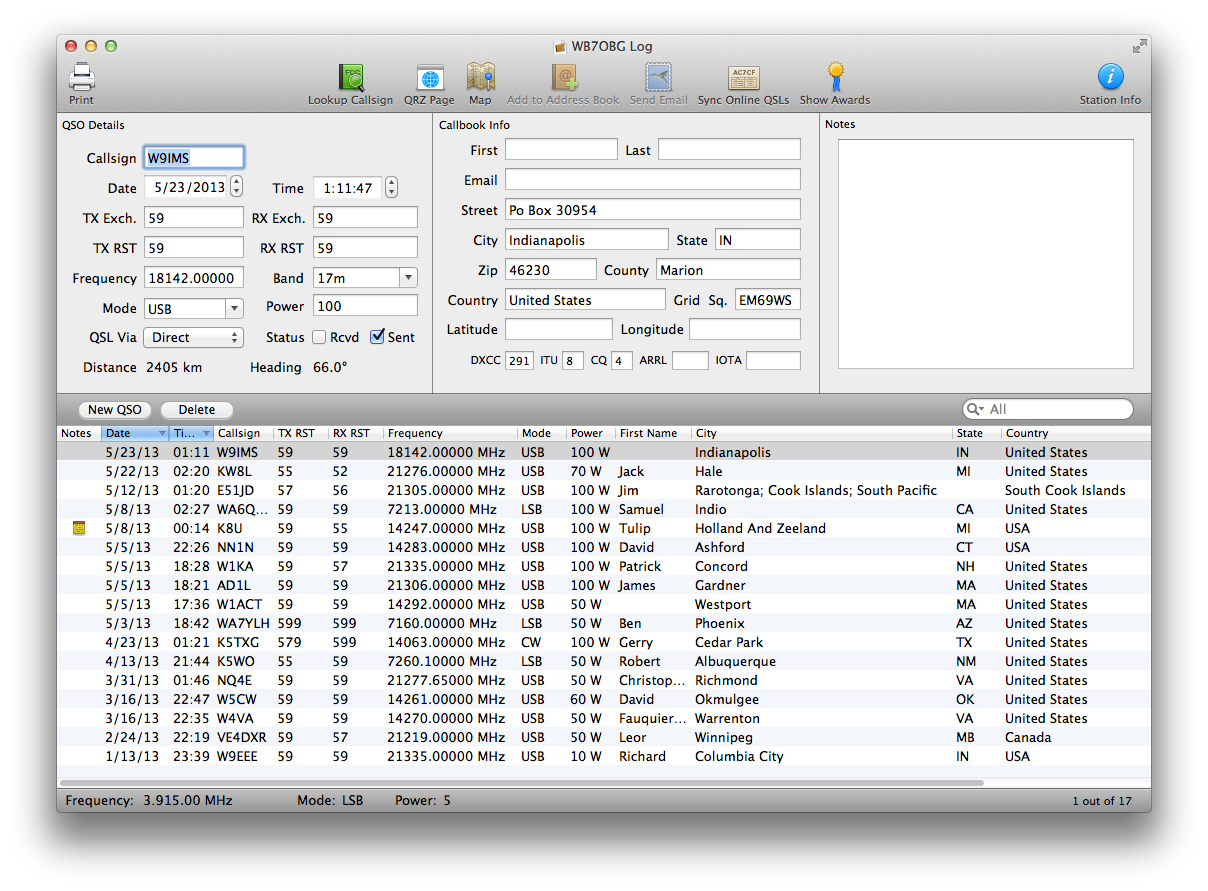
It is a nice clean native Mac application. It interfaces with hamQTH.com or QRZ.com for callsign lookup.  I happen to really like this feature.  While making a new logbook entry, the instant I enter the callsign it looks up the callsign nd automatically fills in the fields. It also automatically computes the beam heading and distance (If I had a beam I could put that feature to use).

It also interfaces very cleanly to my Kenwood TS-590S. I simply run a USB cable between the 590 and my USB hub.  When I create a new logbook entry it automatically fills in the frequency, mode, and power.

Aether also appears to work with cocoaModem but I have not yet played with cocoaModem.

The fully-functional Demo version is free and allows up to 30 logbook entries.  That should be enough time to evaluate it. The full version is $39.  Technical support via email is great.


TS-590 NR Controls Effectively Reduce Static

I’ve owned the Kenwood TS-590s for about 6 months and I’m still learning about it and discovering new capabilities. I’m discovering that careful adjustment of the Noise Reduction controls is very effective at removing static.

The background noise level on 20M is often S9 here, with many weak signals buried in the noise. A fe nights ago I started playing with the NR button and associated controls to see if I could reduce that static and much to my surprise I could.

There are two noise reduction circuits, NR1 and NR2. Repeatedly pressing the NR button cycles through OFF, NR1, and NR2. Holding down the NR button will NR1 or NR2 is displayed activates the MULTI/CH knob and makes the NR circuit adjustable. By careful adjustment,

I can take the background noise way down. It’s not perfect, and you can go overboard to the point that the desired signal gets distorted, so careful adjustments work best.

Back To Top